

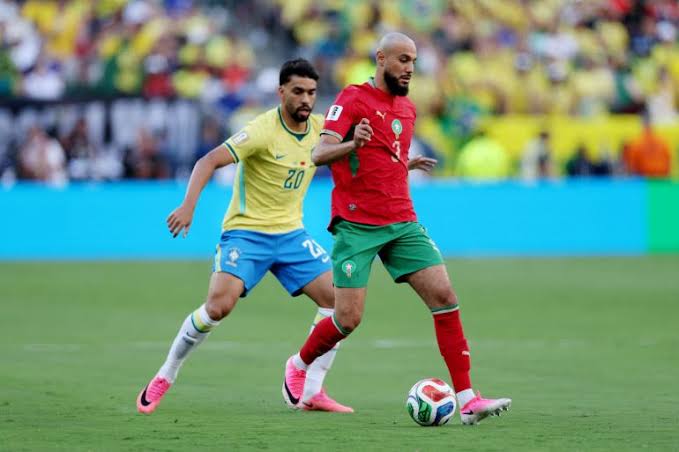
Brazil’s quest for a sixth FIFA World Cup title began with a frustrating setback as Vinícius Júnior’s moment of brilliance was required to salvage a 1-1 draw against a resilient Morocco side in a pulsating Group C encounter at MetLife Stadium on Saturday.
The highly anticipated clash saw Morocco produce another statement performance on the global stage, earning a valuable point against the five-time world champions and reinforcing their status as one of the tournament’s most dangerous teams.
Morocco struck first in the 21st minute through Ismael Saibari, who etched his name into history by scoring the first goal by an African player at the 2026 FIFA World Cup. The PSV Eindhoven midfielder finished off a superb attacking move with a composed and spectacular effort that stunned the thousands of Brazilian supporters inside the 80,663-capacity stadium.
The Atlas Lions, who captivated the football world with their historic run to the semi-finals of the 2022 World Cup, looked confident and well-organised from the opening whistle. Led by captain Achraf Hakimi and backed by goalkeeper Yassine Bounou, Morocco controlled large portions of the first half and exposed several weaknesses in Brazil’s defensive structure.
However, Brazil found their answer through one of their brightest stars.
With the Seleção struggling to find rhythm, Vinícius Júnior produced a trademark moment of individual brilliance in the 32nd minute. The Real Madrid winger exchanged passes with Bruno Guimarães on the left flank before cutting inside and unleashing a powerful right-footed strike beyond Bounou to level the scores. The goal, his 10th for Brazil and his first of the tournament, brought the crowd to life and rescued Carlo Ancelotti’s side from a potentially damaging opening defeat.
Despite Brazil enjoying more possession after the interval, Morocco remained disciplined and dangerous on the counterattack. Bounou produced a series of crucial saves, while the North Africans continued to threaten through Saibari, Brahim Díaz and Azzedine Ounahi.
Ancelotti introduced tactical changes in the second half in an attempt to spark his side into life, but Brazil never truly hit top gear. The South Americans looked surprisingly vulnerable in midfield and lacked the fluid attacking football that has long defined the Seleção.
Speaking after the match, Vinícius admitted Brazil had not started well and acknowledged the need for improvement as the tournament progresses.
For Morocco, the draw represents another significant milestone for African football and further evidence that their success in Qatar four years ago was no fluke. The Atlas Lions matched Brazil physically, tactically and technically, leaving MetLife Stadium with a deserved point and renewed belief ahead of their remaining group-stage fixtures.
While Brazil avoided an opening-match defeat thanks to Vinícius Júnior’s heroics, the performance raised serious questions about their readiness to challenge for the world title. Morocco, meanwhile, emerged with growing confidence and the satisfaction of having gone toe-to-toe with one of football’s greatest nations.
